Press contact
Sedus Pressestelle
Christof-Stoll-Straße 1
79804 Dogern
Tel.: +49 (0) 7751 84 - 320
E-Mail: presse@sedus.com
Sedus Pressestelle
Christof-Stoll-Straße 1
79804 Dogern
Tel.: +49 (0) 7751 84 - 320
E-Mail: presse@sedus.com
Dogern, 28.07.2026
The most valuable conversations often don’t take place where they’re planned. Not in a formal meeting. Not in a workshop. Not on the agenda. They happen in between: on the way to grab a coffee, during a brief chat on the stairs, in a chance exchange between two departments that are barely connected on the organisational chart. These are precisely the moments that companies need to recognise and value. In a workplace that has become more hybrid, flexible and digital, it is not just the location of work that is changing. The way people build relationships, share knowledge and experience culture is changing too.
“In organisational research, such loose, informal connections are known as ‘weak ties’,” explains Ernst Holzapfel, Marketing Director at Sedus. “Sociologist Mark Granovetter demonstrated in his theory ‘The Strength of Weak Ties’ that it is precisely these weak connections that are often particularly valuable: weak ties do not merely bring new information and perspectives into an organisation. They promote exchange between departments, strengthen the sense of belonging and build trust across team and departmental boundaries. In doing so, they make an important contribution to an open, interconnected corporate culture.”
For companies, the implication is clear: successful collaboration is built on more than expertise alone. It arises from connection. From people who meet, even though they do not regularly work together. From conversations that were not planned. From trust that grows across team and departmental boundaries. And from spaces that make such encounters possible.
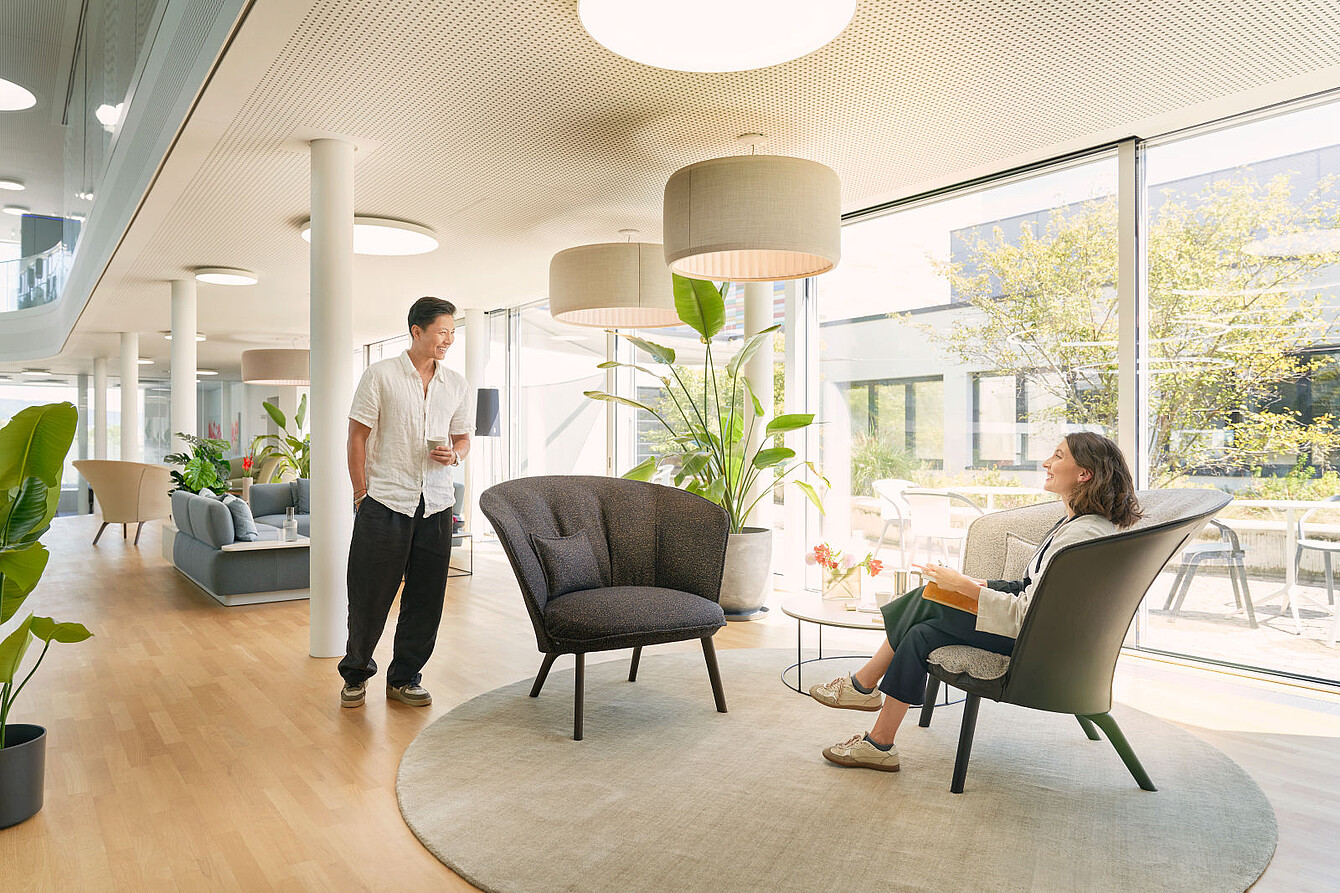
This is where the concept of ‘Crossroads’ comes into play. Crossroads are more than just traffic areas. They are spatial intersections within the organisation; places where paths cross, people meet and spontaneous conversations arise. A staircase, café area, lounge, central meeting point or shared project space can fulfil precisely this function. They connect what structures often separate: teams, departments, hierarchies and perspectives.
One example of this is easyCredit’s new working environment in Nuremberg. The head office was conceived not merely as an office building, but as a physical expression of a modern organisation. Workflows, collaboration and spatial design are interwoven. Open-plan areas, meeting zones and flexible workplaces support agile working practices and encourage interaction across traditional boundaries. In this way, the workplace becomes more than just a backdrop it becomes an active part of the organisation’s culture.
“Informal encounters play a central role in the concept of ‘Crossroads’,” explains Holzapfel. “They build trust before it is needed. They reduce silo thinking before it becomes a problem. They make organisations more agilebecause information is not merely passed on formally, but flows dynamically through the company.”
This becomes even more important in hybrid working models. When it is no longer a given that employees will be in the same place every day, the physical space must fulfil a new purpose. It needs to offer more than just a desk. It must offer people a reason to come in. A place for a sense of belonging, inspiration and meaningful interaction. A place where people feel that their work is part of something bigger.
The role of the modern workplace is about more than organising space efficiently. It is about creating opportunities for people to connect. Spaces must be designed in such a way that they facilitate concentration whilst simultaneously fostering connection. They must offer a place of retreat, yet also create a sense of openness. They must support individual work whilst simultaneously creating ‘crossroads’ where corporate culture becomes tangible.
“Ultimately, it is not square metres that make a company successful. It is people. And people need connection,” says Holzapfel. “Weak ties, crossroads and informal encounters show that the value of an office lies not solely in its floor space, but in its ability to bring people together. Where people meet, trust is built. Where trust is built, collaboration becomes easier and where collaboration becomes easier, new ideas emerge. That is why social hubs are becoming increasingly important in the design of modern working environments.”
The full easyCredit case study is available to download free of charge in issue no. 2 of the Sedus INSIGHTS Trend Barometer: https://www.sedus.com/en/knowledge/trend-monitor-sedus-insights/insights-02
You can also download all the images and documents from the Sedus Media Center.