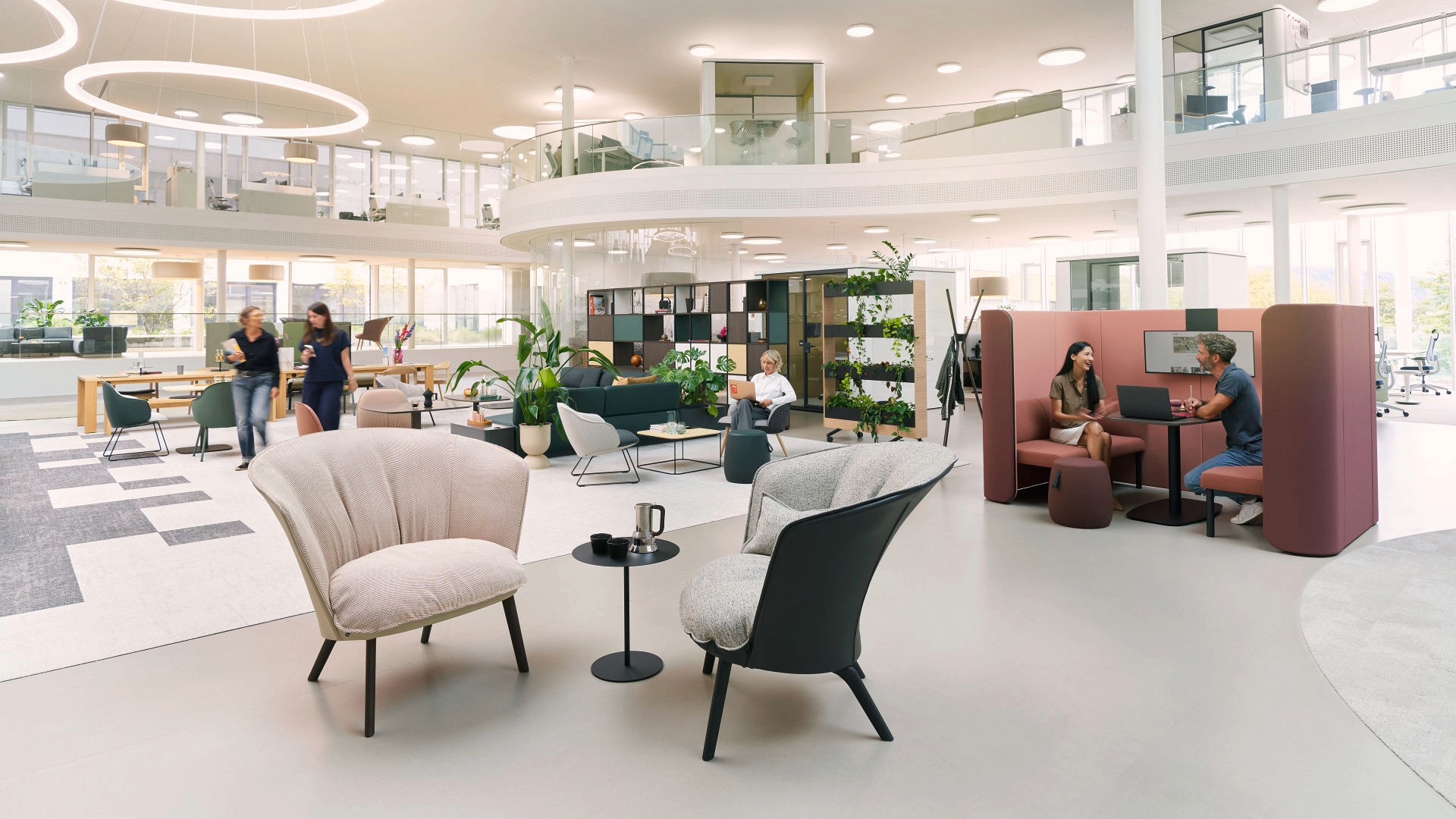

This is where se:cove demonstrates its versatility. The lounge chair combines seclusion with openness, comfort with presence. Depending on its position, configuration and spatial context, it can fulfil a wide variety of roles: from a personal focus spot to a relaxed break area, and an informal meeting place for discussion and co-creation.
When planning a space, it is therefore important to ask not only, ‘Where does se:cove fit in?’, but also, ‘What work scenarios should take place there?’
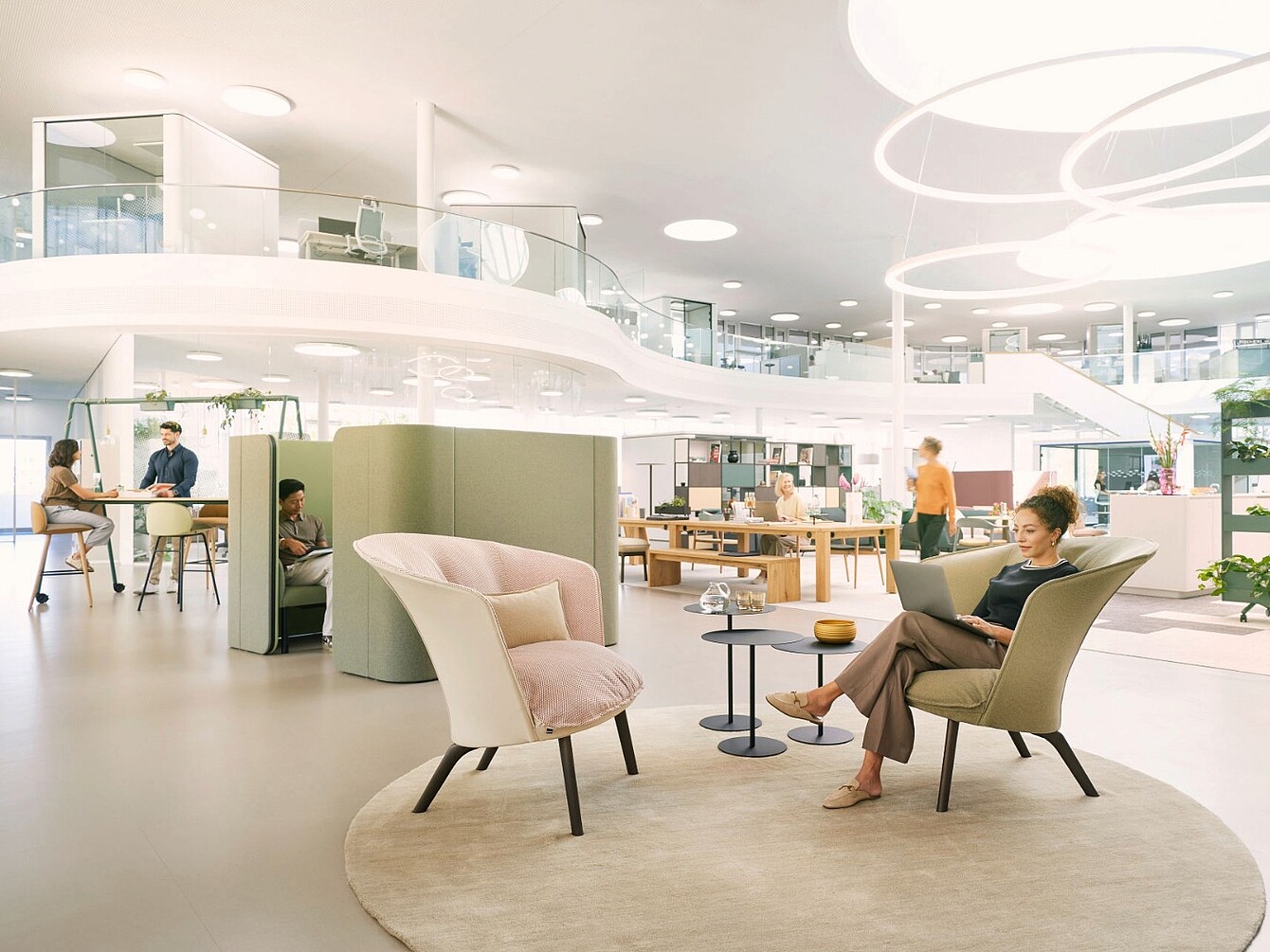
Scenario 1: Focus – a personal retreat in an open-plan space
A laptop, a task, an hour of concentration: not every period of focus requires a traditional desk or an enclosed room.
Particularly for reading, researching, reflecting or concentrated individual work, more informal settings in the hybrid office can be a valuable alternative. se:cove creates a clearly defined personal space for this purpose. Its enveloping shape provides support and reduces visual distractions, whilst the open front maintains a connection to the surroundings.
This makes the armchair particularly suitable for library zones, quiet peripheral areas or small focus islands. Combined with a side table, just a few elements create a straightforward workspace for temporary periods of concentration.
A key planning consideration: Focus does not automatically have to mean isolation. Strategically placed soft seating creates micro-retreats that blend naturally into open-plan spaces.

Scenario 2: Break – step out briefly without leaving the room
Ten minutes to catch your breath between two meetings. Have a coffee. Gather your thoughts. Or simply change your sitting position.
Breaks are, of course, part of everyday working life. However, they require spaces that physically support this change of pace. This is where se:cove’s homely character comes into its own. The generous upholstery and curved shape immediately signal that this is a place where you can settle in and relax.
Particularly in work cafés, breakout areas or transition zones, this creates a welcome contrast to traditional workstations. This is especially important in the hybrid office: when staff make a conscious decision to come into the office, it’s not just about productive work but also about the quality of the environment. Spaces should therefore not only provide workstations but also support different situations that arise throughout the day.
A key planning consideration: An attractive office needs spaces for the moments between tasks. Soft seating makes regeneration visible and creates a pleasant environment in areas that would otherwise often remain unused.
Scenario 3: Interaction – informal rather than a meeting room
Not every conversation needs a table, a screen and four walls.
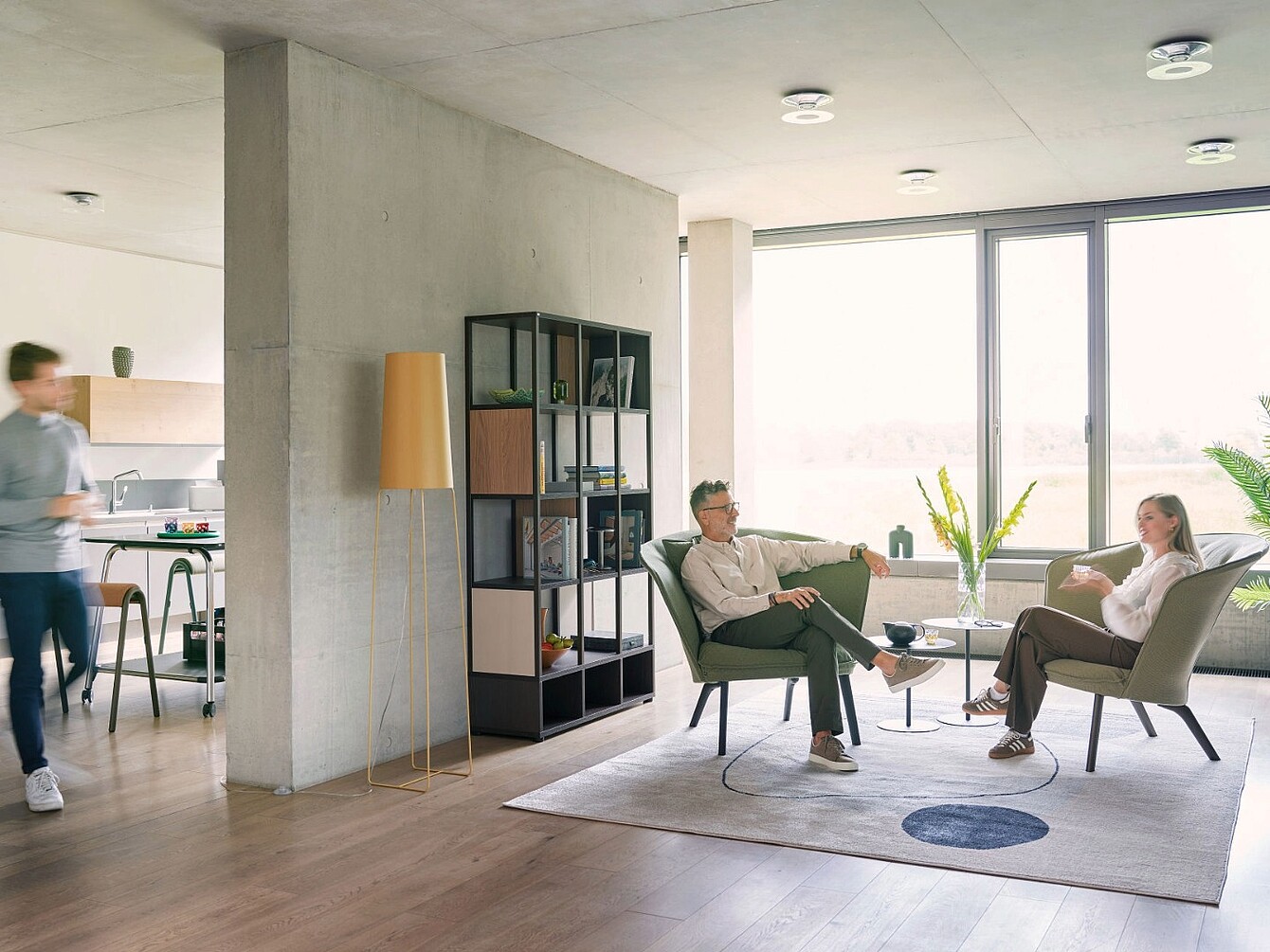
A quick update with a colleague or a spontaneous chat after an appointment often works better in a more informal setting. Two se:cove units, facing each other or angled slightly towards one another, create a small conversation island for this purpose. The open front is inviting, while the shape of the backrest gives those seated a sense of protection.
Combined with a low side table, this arrangement is suitable for both brief coordination sessions and longer discussions. In the Work Café, communication zones, reception areas or between team spaces, it creates an alternative to the traditional meeting room.
A key planning consideration: Informal meeting spaces take the pressure off formal meeting areas and expand the range of settings available. Employees can choose the location to suit the occasion.
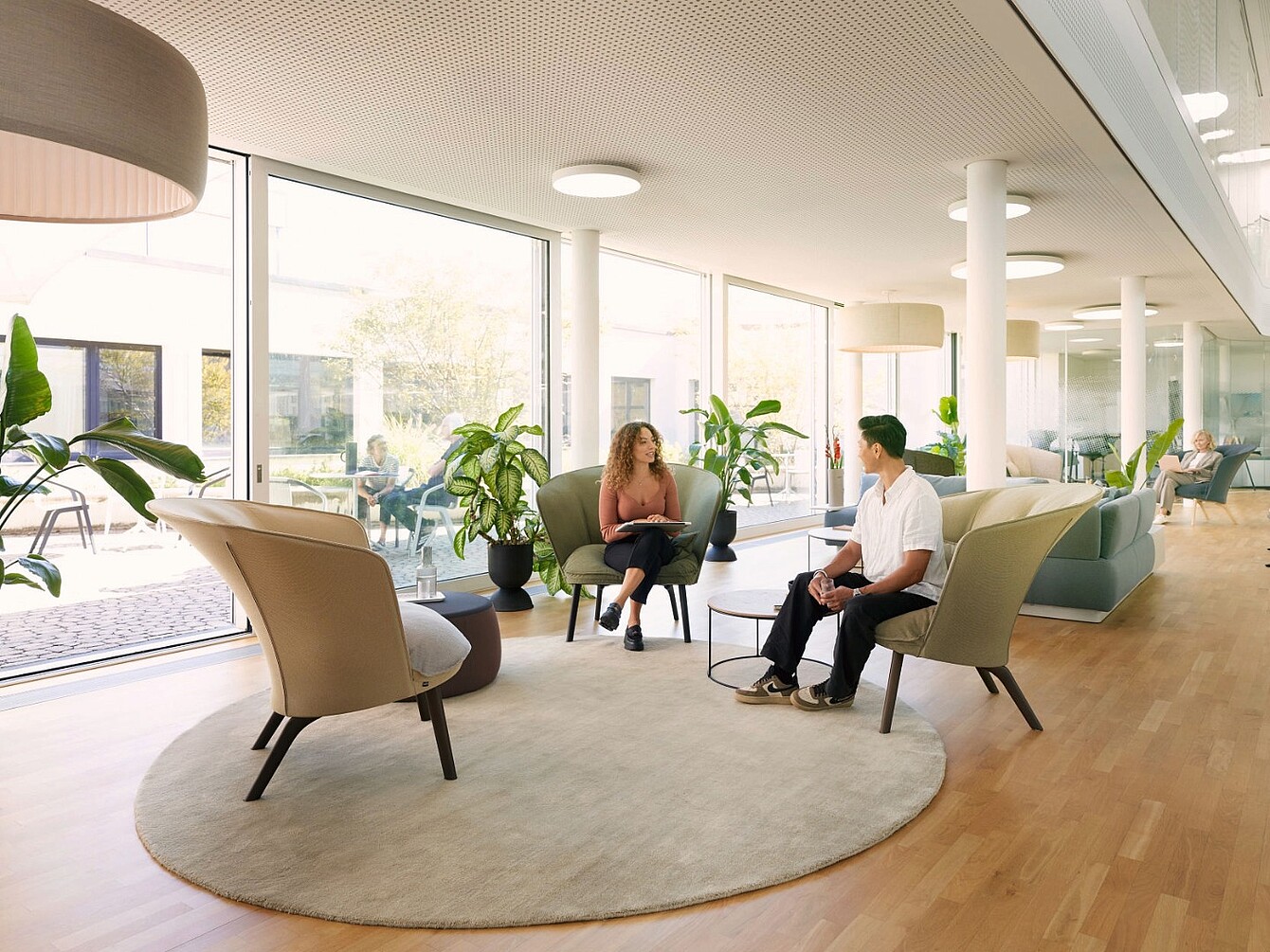
Scenario 4: Co-creation – collaboration in a relaxed atmosphere
Creative collaboration rarely follows a linear path. Sometimes people discuss, sometimes they listen, sometimes they do a quick search on their laptop or develop an idea further. Spaces should therefore be flexible enough to accommodate these different modes of working.
Several se:cove units can be arranged into loose groups, creating settings for brainstorming, project discussions or smaller co-creation sessions. Unlike a traditional conference table, this creates a less formal atmosphere that supports the transition between conversation, reflection and spontaneous collaboration.
se:cove doesn’t have to stand alone. Combined with side tables, mobile workstations or additional seating, it can transform a lounge area into a versatile project space. Its strength lies in its adaptability: what serves as a space for concentrated reading in the morning can later become part of a spontaneous team discussion.
A key planning consideration: Hybrid spaces become more valuable when a setting supports more than one mode of use. This creates functional diversity without the need for a separate room for every activity.
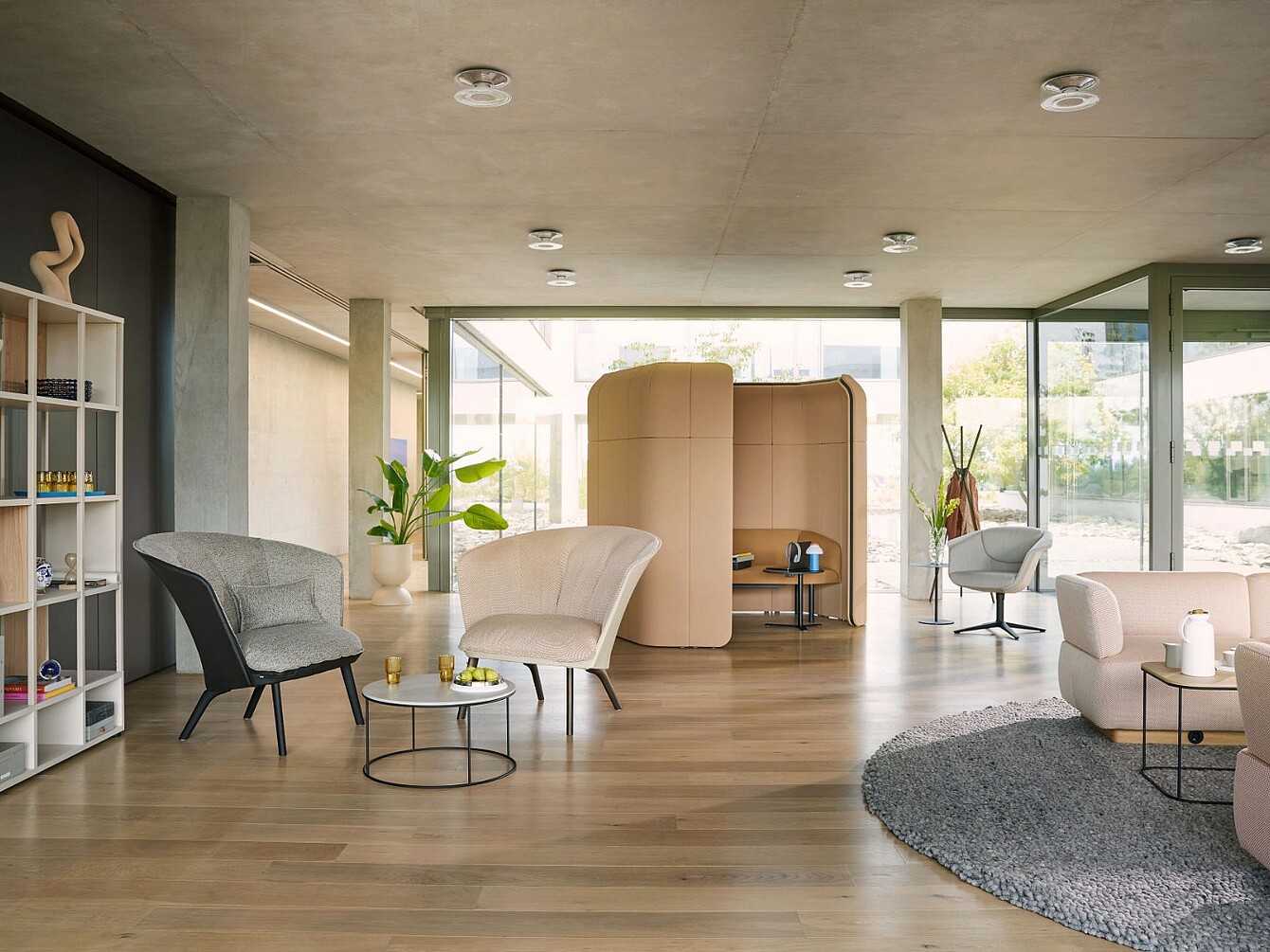
Scenario 5: Orientation – when an armchair becomes a spatial tool
se:cove does more than simply support different activities. Its positioning can also play an active role in space planning.
The open front and the distinctly defined rear create two different effects: facing forwards, the armchair invites use; facing backwards, it has a structuring and space-defining effect. Its orientation can therefore influence how a zone is perceived.
Placed with its back to a walkway, for example, se:cove can delineate a more sheltered lounge area. Several armchairs can organise an open space into a small island. At transitions between areas designed for concentration and those for communication, the armchair becomes a point of orientation. In this way, the furniture fulfils a role that would otherwise require additional room dividers or structural elements: it creates structure without drawing hard boundaries.
A key planning consideration: Furniture can not only furnish a space but also actively structure it. se:cove’s dual design therefore makes its orientation an additional planning parameter.
One piece of furniture, multiple possibilities
A focal point or a break area? A place for conversation or a co-creation setting? A retreat or a space-defining element? With se:cove, the answer is: it depends on the context.
This is precisely where its strength lies for hybrid office concepts. Modern working environments do not necessarily require an ever-increasing variety of furniture types. Above all, they need solutions that support different activities and allow spaces to be interpreted flexibly.
Added to this is its design flexibility: seat cushions, inner backrest cushions and outer backrest cushions can be configured independently of one another. There is also a choice between a four-leg wooden base and a four-leg aluminium base. This allows se:cove to be tailored to different colour, material and spatial concepts.
Sustainability has also been a key consideration from the outset: at the end of its life cycle, se:cove can be completely dismantled into individual parts and, depending on the version, contains a high proportion of recycled materials. Replaceable covers further support long-term use.
This transforms a lounge chair into a versatile tool for designing hybrid working environments: a place for concentration, a space to recharge, a meeting point for exchange and a platform for new ideas. Or, in short: one armchair, many scenarios.

social media channels: