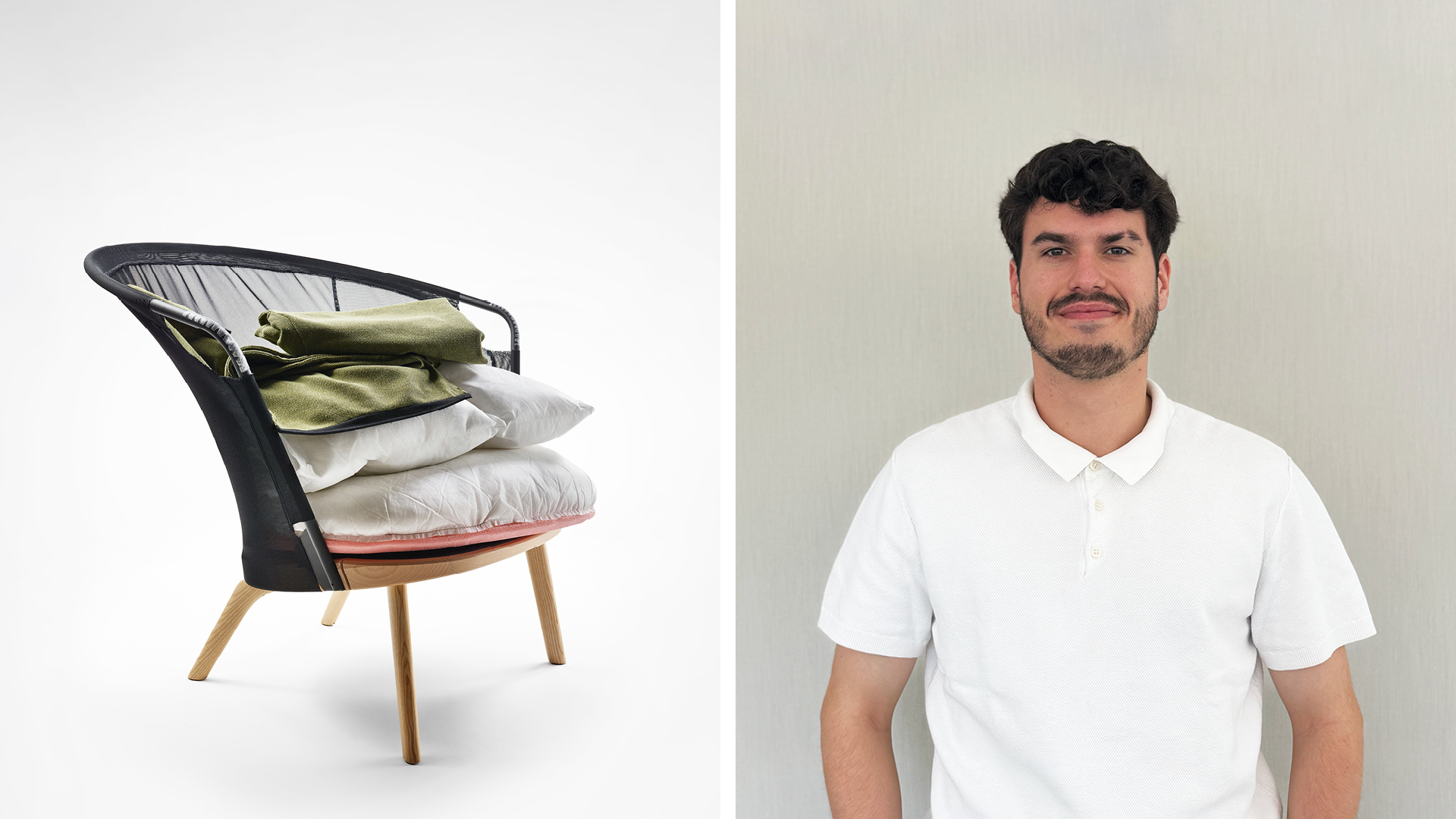

“Considerably more than one might assume at first glance.”
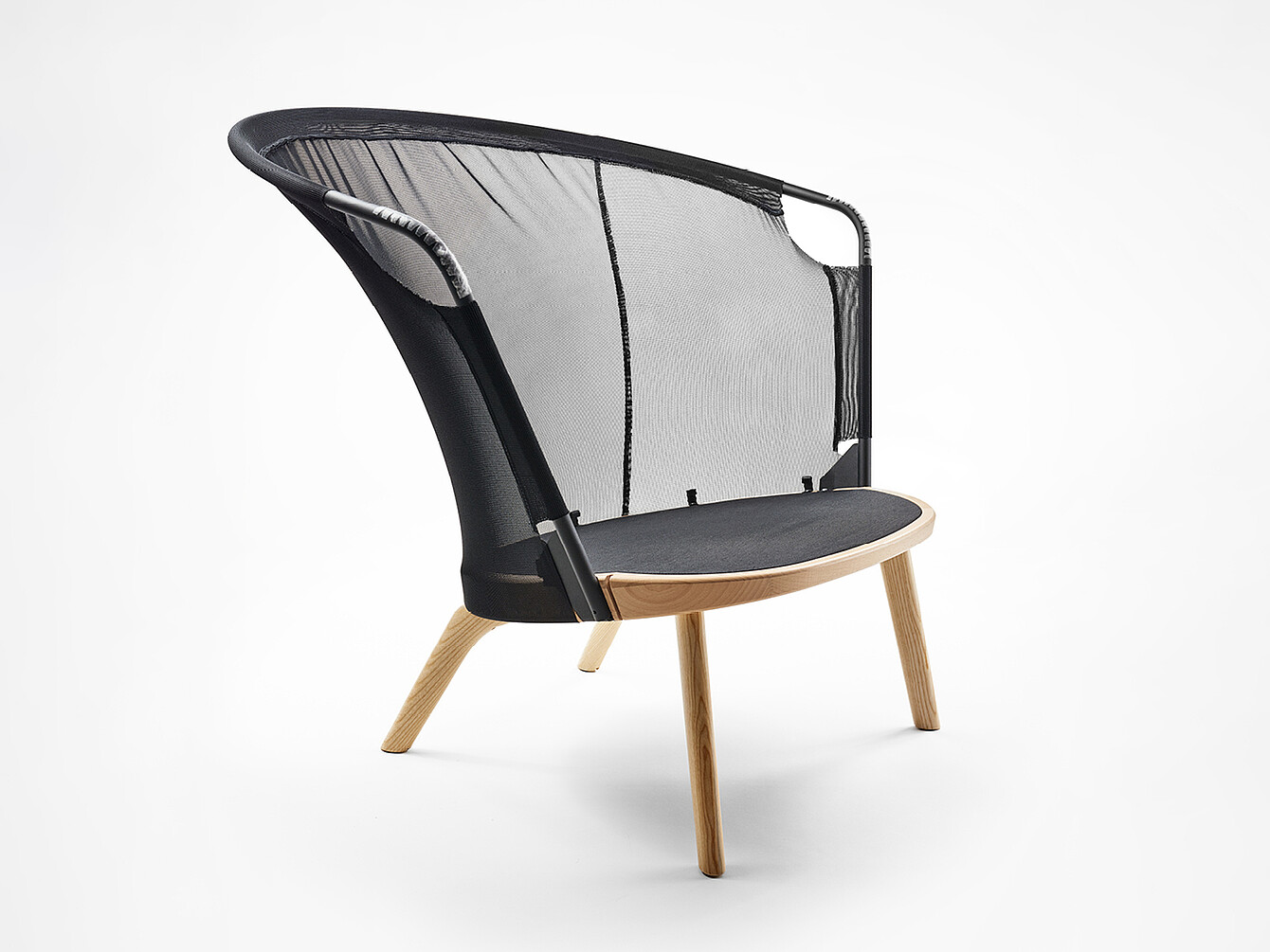
se:cove initially presents itself as a comfortable lounge chair - but how much sustainability effort actually goes into such a product?
“I would say: considerably more than one might assume at first glance. With se:cove, we succeeded in not viewing design and sustainability as opposites, but in consistently bringing them together. Often, a product’s design significantly limits the possibilities in terms of sustainability. se:cove, on the other hand, was deliberately designed to preserve this flexibility.”
This is by no means self-evident in product development. Design decisions determine early on which materials are feasible, how constructions are implemented and how effectively a product can be recycled later. With se:cove, this scope was intentionally kept open - forming the foundation for sustainable decision-making.
Sustainability from the Very Beginning
The sustainability team is not involved at the end of the development process, but from the outset. Niklas explains:
“We are involved in the development process from the very beginning. As soon as the basic product idea is defined, we provide recommendations on which criteria should be considered in order to achieve a sustainable product in the end. For example, we define the target percentage of recycled materials and the maximum allowable CO₂ footprint.”
This means that clear targets are established at an early stage - whether for recycled content or for maximum carbon emissions. Sustainability thus becomes a measurable parameter rather than an abstract aspiration.
Up to 68% Recycled Materials — A Decisive Lever
One central outcome of this approach: se:cove consists of up to 68% recycled materials. This is not merely a figure, but a powerful lever for reducing emissions.
Depending on the configuration, the carbon footprint amounts to 30.4 kg CO₂ equivalent - and in another version, as low as 12.5 kg CO₂ equivalent. These figures are based on a so-called cradle-to-gate assessment.
What does that mean in concrete terms?
“These values are based on the cradle-to-gate assessment. This means that raw material extraction, transport to our production facility and manufacturing are taken into account. Sedus already stands for sustainable production, which is why we focus primarily on the use of sustainable materials. The most effective lever is the use of materials with a high recycled content. se:cove consists of up to 68% recycled materials. In this way, we were able to significantly reduce the CO₂ footprint.”
Cradle-to-gate therefore includes all emissions from raw material extraction through to the finished product leaving the factory gate - before it is transported to or used by the customer. Particularly in these early phases, there is significant potential for reduction, especially through material selection.
Regional Sourcing: Ecologically and Socially Relevant

Beyond material composition, the origin of components also plays a central role. Around two-thirds of Sedus materials are sourced from Germany, and 91% from Europe. For se:cove, sourcing is even 100% European.
For Niklas, this represents far more than a logistical advantage:
“Regional sourcing offers both ecological and social benefits for us. From an ecological perspective, regionality reduces the CO₂ footprint associated with transport. Two-thirds from Germany means that two-thirds of our materials are produced according to German standards; 91% according to European standards. Thanks to the high European standards, we can ensure that strong ecological and social requirements are met by our suppliers. se:cove itself is sourced entirely from European countries.”
Shorter transport routes reduce emissions - while European standards help ensure that environmental and social requirements are upheld throughout the supply chain.
Responsibility for People: Occupational Safety as a Core Element
At Sedus, sustainability encompasses not only environmental and climate protection, but also responsibility toward people in production.
“Occupational safety in production is of great importance to Sedus, which is why in 2019 we decided to have our existing occupational health and safety management system certified according to ISO 45001. Safety has the highest priority in our production and is an integral part of all processes. Through clear structures, regular reviews and the active involvement of our employees, we create a working environment that minimises risks and consistently places prevention at the forefront.”
In practical terms, this includes structured annual workplace inspections, quarterly safety committee meetings, and transparent evaluations of accident statistics and improvement measures.
“Our workplaces and production areas are reviewed annually as part of structured inspections together with managers and relevant specialist departments. In doing so, we identify potential hazards at an early stage and implement targeted optimisation measures. In addition, quarterly safety committee meetings are held to transparently evaluate current developments, accident statistics and improvement measures, and to further develop them.
The active participation of our employees also plays a decisive role. Near misses and safety-related observations can be reported easily in order to identify potential risks early and prevent future incidents. Regular training sessions strengthen safety awareness and promote a culture of attentiveness and personal responsibility.”
In practice, ISO 45001 therefore stands for a systematic, verifiable occupational health and safety management system - and for a safety culture that is continuously evolving.
Design for Recycling: Considering Every Phase of the Lifecycle
Another central aspect is taking every phase of a product’s lifecycle into account. For se:cove, this means:
“With se:cove, we applied the design-for-recycling concept. The product is designed in such a way that it can be disassembled into its individual components at the end of its life and fully recycled. It was also developed for an extended lifecycle: feet or covers can be replaced, allowing the product to be used for longer.”
The objective is clear: to design products that are repairable, easy to disassemble and capable of being returned to the material cycle as completely as possible - in line with circular economy principles.
One Product, Multiple Sustainability Arguments
What distinguishes se:cove from a sustainability perspective? For Niklas, it is the interplay of multiple factors:
“With se:cove, we cover all aspects of our Sedus Green Codex - our approach to the circular economy. It is encouraging to see that we were able to address each of these aspects - from design for recycling and European material sourcing to a high percentage of recycled materials.”
There is no single outstanding sustainability argument:
“There is not just one sustainability argument for se:cove. It is characterised by many different ones. We have also seen a development in our foam system for the first time. Here, we are using 30% bio-based content. I see significant development potential here and hope that we can transfer this upward trend to other products as well.”
This bio-based component in the foam system demonstrates that sustainability is an ongoing process - with continued potential for innovation.
Conclusion
se:cove is more than a lounge chair. It exemplifies a development approach in which design, functionality and sustainability are considered together from the outset.
From material selection and regional sourcing to occupational safety and recyclability, one thing becomes clear: sustainability is not an add-on - it is an integral part of the product itself.

social media channels: