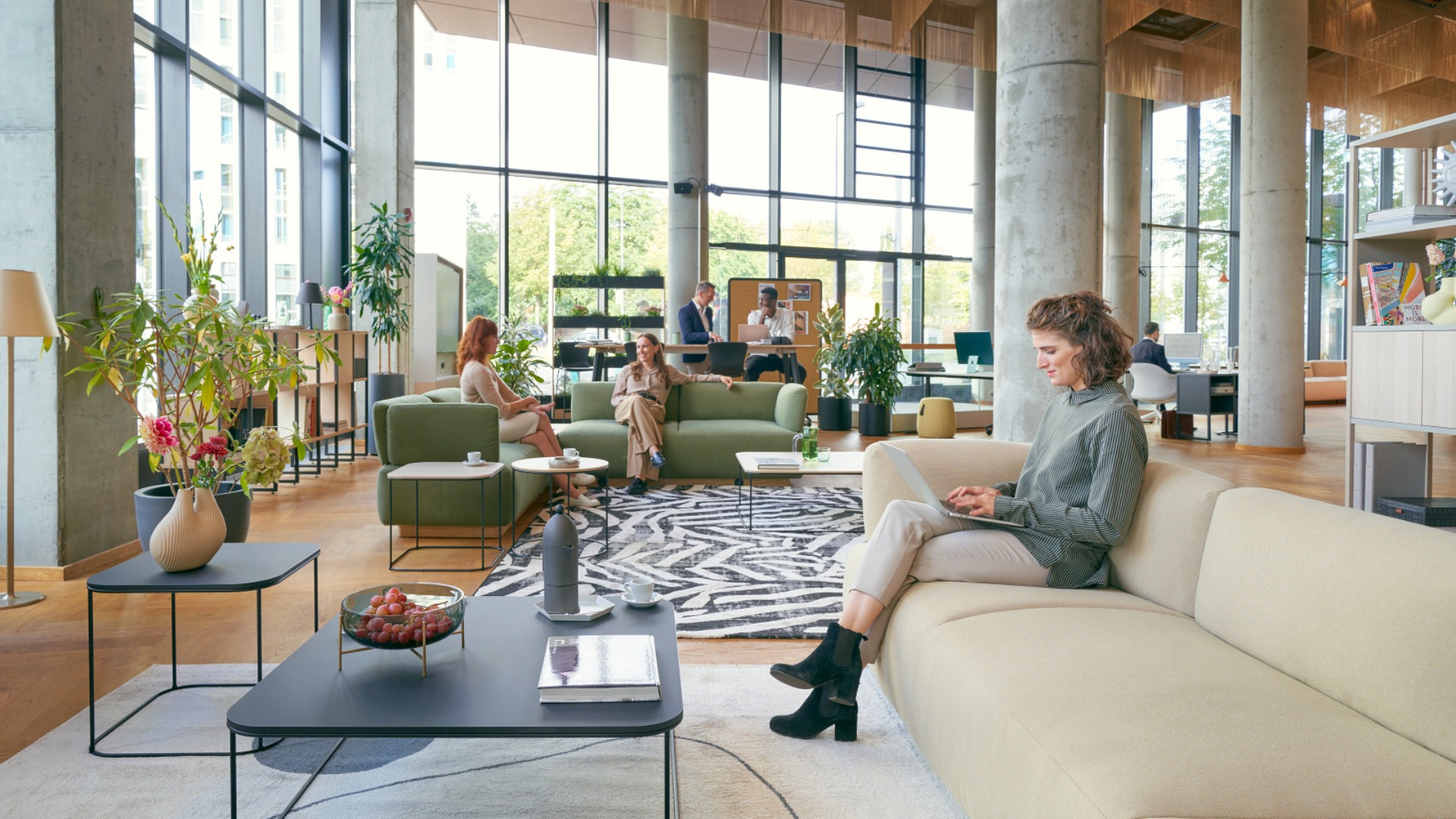

Spaces are more than just the backdrop to our work
We enter a room and often sense within just a few seconds how it affects us.
Some places spark curiosity. Others convey a sense of calm. Some invite us to stop and strike up a conversation. And still others signal quite naturally: This is somewhere I can retreat and concentrate.
Spaces influence how we move, where we spend time, whom we encounter and how we work together.
This makes work environments far more than a functional shell for desks, meeting rooms and technology. They can provide orientation, support behaviour, make corporate culture tangible and create conditions in which people enjoy their work and can do it well.
This impact is becoming particularly important in a hybrid working world.
Because when employees can choose between the office, home office and other places of work, the office has to offer more than simply a workstation.
There needs to be a reason to be there. And that is precisely where the Power of Space comes into play.
Space plays an active role
For a long time, office planning centred primarily on one question: How can the available space be used as efficiently as possible?
How many workstations can fit in? Where should meeting rooms be located? How can walking distances be kept as short as possible?
These questions remain important. But they do not go far enough.
After all, a workstation does not function well simply because it has a desk, a chair and a screen.
Throughout the working day, people constantly shift between different needs. They concentrate, communicate, develop ideas, make decisions, learn, make phone calls, give presentations or simply need a moment to step away.
A good working environment takes precisely these changes into account.
Instead of offering one workstation for everything, it provides different spatial options for different situations.
An open area can encourage quick exchanges. A sheltered workstation supports concentration. A lounge can facilitate informal conversations. A Work Café brings people together. A small retreat offers peace and quiet.
Space thus becomes a tool in its own right.
Not by dictating how people must work.
But by allowing them to choose the place that best suits the task at hand.
This freedom of choice is playing an increasingly important role in modern work environments. The Sedus article “Choice as a Driver of Productivity” explains why not every task requires the same environment and how a variety of spatial options can help support focus, satisfaction and performance.
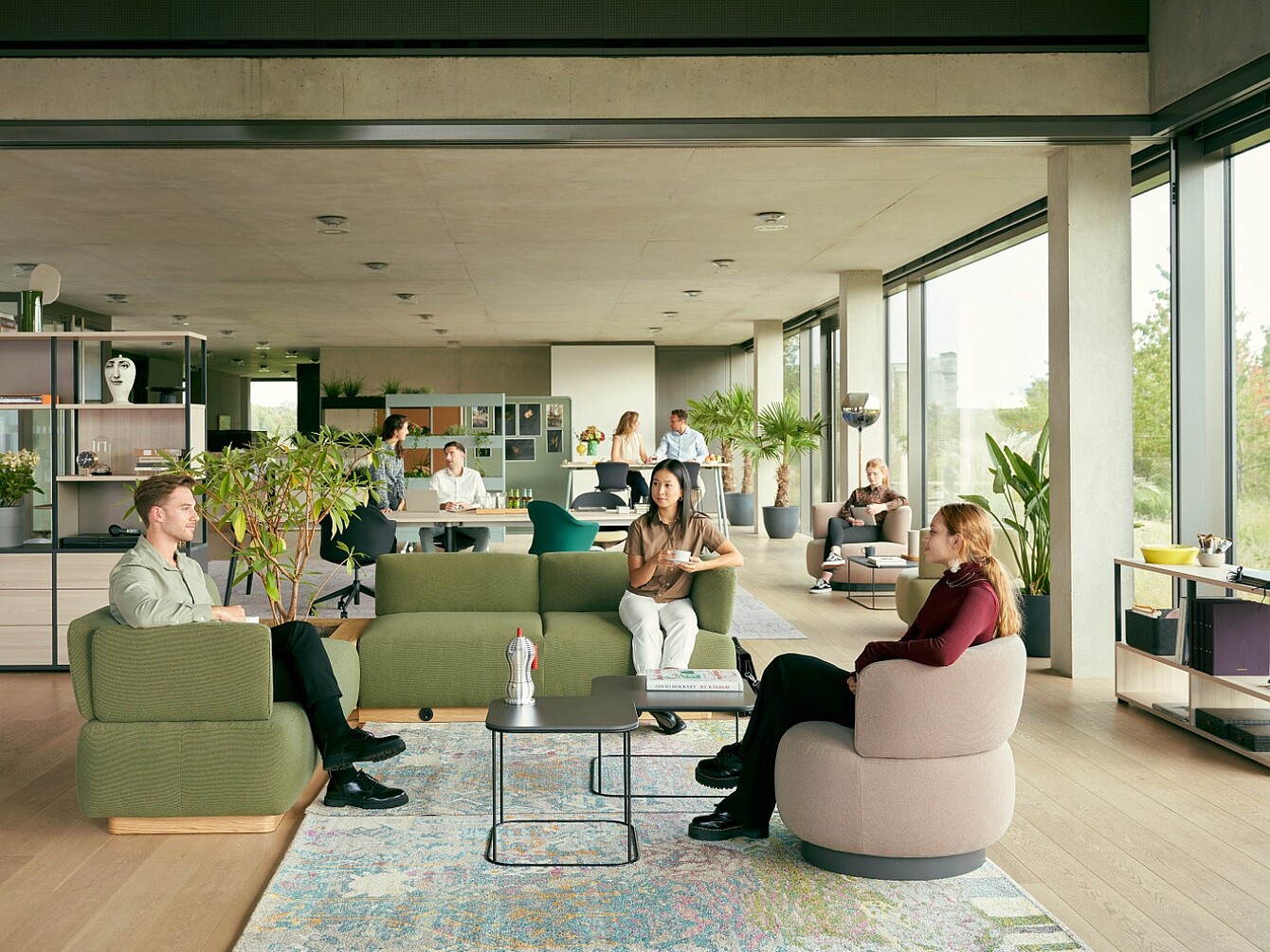
Inspiration does not emerge in a vacuum
Creativity cannot be switched on at the touch of a button.
But the environment can help new ideas emerge more easily.
Light, colours, materials, plants, acoustics and different spatial perspectives shape how an environment is perceived. At the same time, design determines whether people spend their entire working day in the same place or move repeatedly through different areas.
It is precisely this change that can be valuable.
A brief change of location breaks up routines.
Our perspective shifts.
Other people come into view.
New stimuli arise.
Sometimes, simply moving from a conventional workstation to a more informal setting is enough to view a topic from a different perspective.
Inspiring work environments do not therefore have to be spectacular.
It is not about using as many colours, unusual pieces of furniture or constantly changing stimuli as possible. Quite the opposite: Too much stimulation can quickly become an additional burden.
What matters is a balanced interplay.
A space should be able to energise when energy and interaction are needed, and take a step back when focus is required.
Inspiration comes not from maximum design, but from appropriate design.
Different tasks need different spaces
What works in the morning may no longer be the right environment in the afternoon.
An employee might start the day with focused individual work, then coordinate with their team, take a confidential video call and spend the afternoon developing new ideas with colleagues.
Four situations with completely different spatial requirements.
The quality of a work environment is therefore not defined solely by how attractively an individual area is designed. What matters is how the different options work together.
From lively, open areas, the workplace landscape can gradually transition into quieter, more secluded settings. Added to these are spaces for relaxation, informal conversations or a brief change of scene.
The result is not a static office, but a spatial system that supports the natural rhythm of a working day.
This perspective is also at the heart of the Sedus article “Office space design and the Changing Needs of Employees”: Modern work environments should respond not only to efficiency requirements, but also to social, emotional and individual needs.
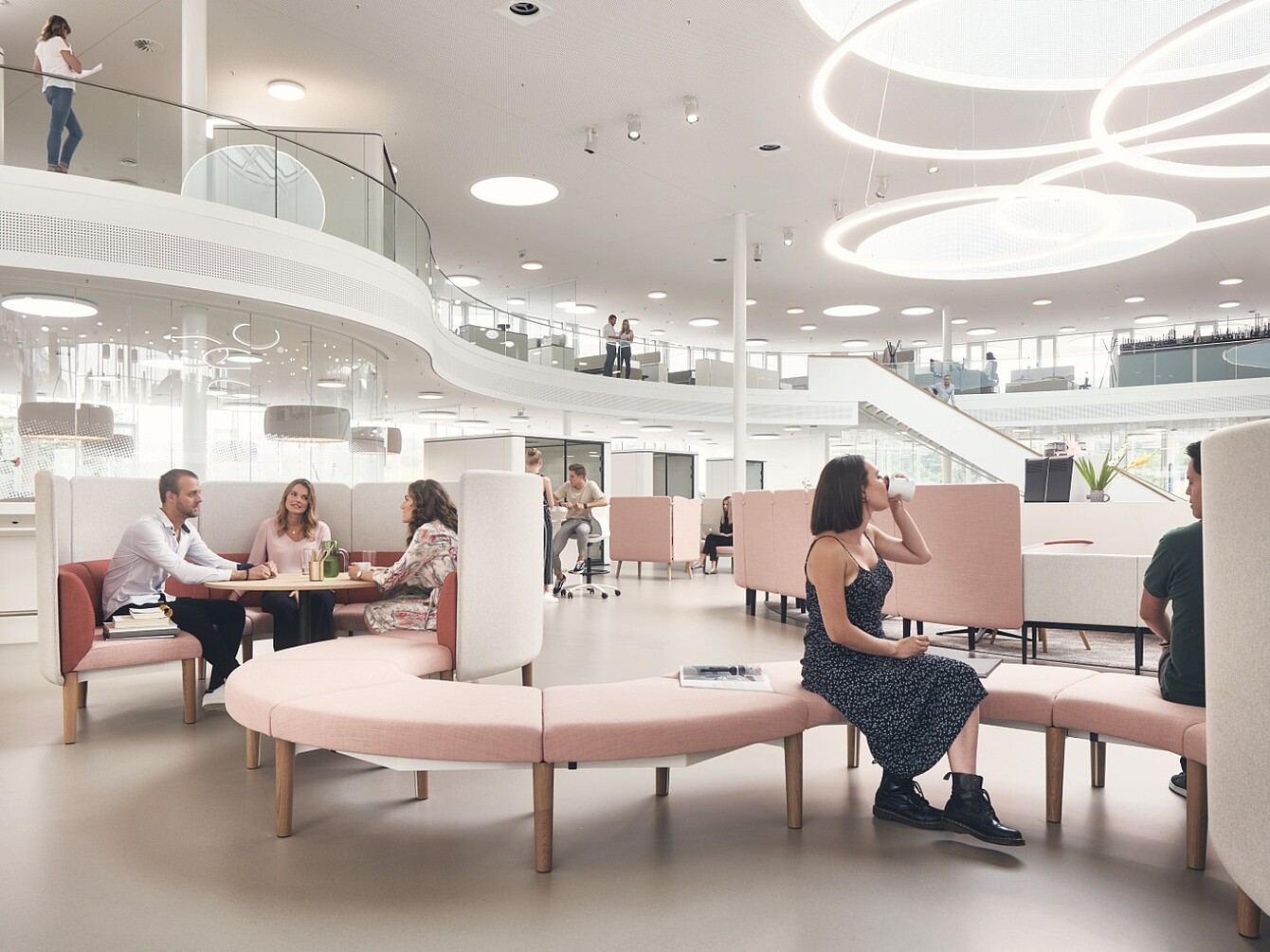
Collaboration needs more than a meeting room
Collaboration now happens everywhere:
- On video calls with international colleagues
- Via digital platforms
- In project meetings
- During spontaneous exchanges between two appointments…
…or in a brief discussion at a shared table.
That is precisely why the role of the office is changing, too.
When the simple exchange of information can take place digitally without difficulty, the physical work environment comes into its own where being present offers genuine added value:
- When people think together
- When ideas are made visible
- When questions can be asked immediately
- When body language and atmosphere matter…
…or when a planned meeting leads to an unplanned conversation afterwards.
However, simply putting people in the same room is not enough.
Collaboration calls for different settings.
Sometimes a team needs a large table and a screen. Sometimes an informal seating area. Sometimes enough room to make ideas visible. And sometimes just a small place where two people can talk for ten minutes.
Good spatial design does not therefore create one perfect collaboration space.
It creates a landscape of different possibilities.
That way, space can adapt to collaboration, rather than collaboration having to adapt to space.
Enabling encounters without forcing them
Not every form of collaboration begins with a calendar invitation.
Many valuable conversations happen unexpectedly.
People cross paths on the way to get coffee, spot someone from another project or stay together for a few minutes after a meeting.
Such situations may seem insignificant at first. Yet they can play an important role in an organisation’s social cohesion and the exchange of knowledge.
After all, companies do not function solely through organisational charts, processes and digital channels.
They function through relationships.
Work environments can support these relationships by creating places where encounters can happen naturally:
- A centrally located Work Café.
- An attractive communal area.
- A standing table between different work areas.
- A meeting point near conference rooms.
- Or simply an area where people enjoy lingering for a few extra minutes.
The crucial point is this: Encounters should be possible, but never compulsory.
A good office creates opportunities.
It does not force anyone to take them.
When the Work Café becomes a social hub
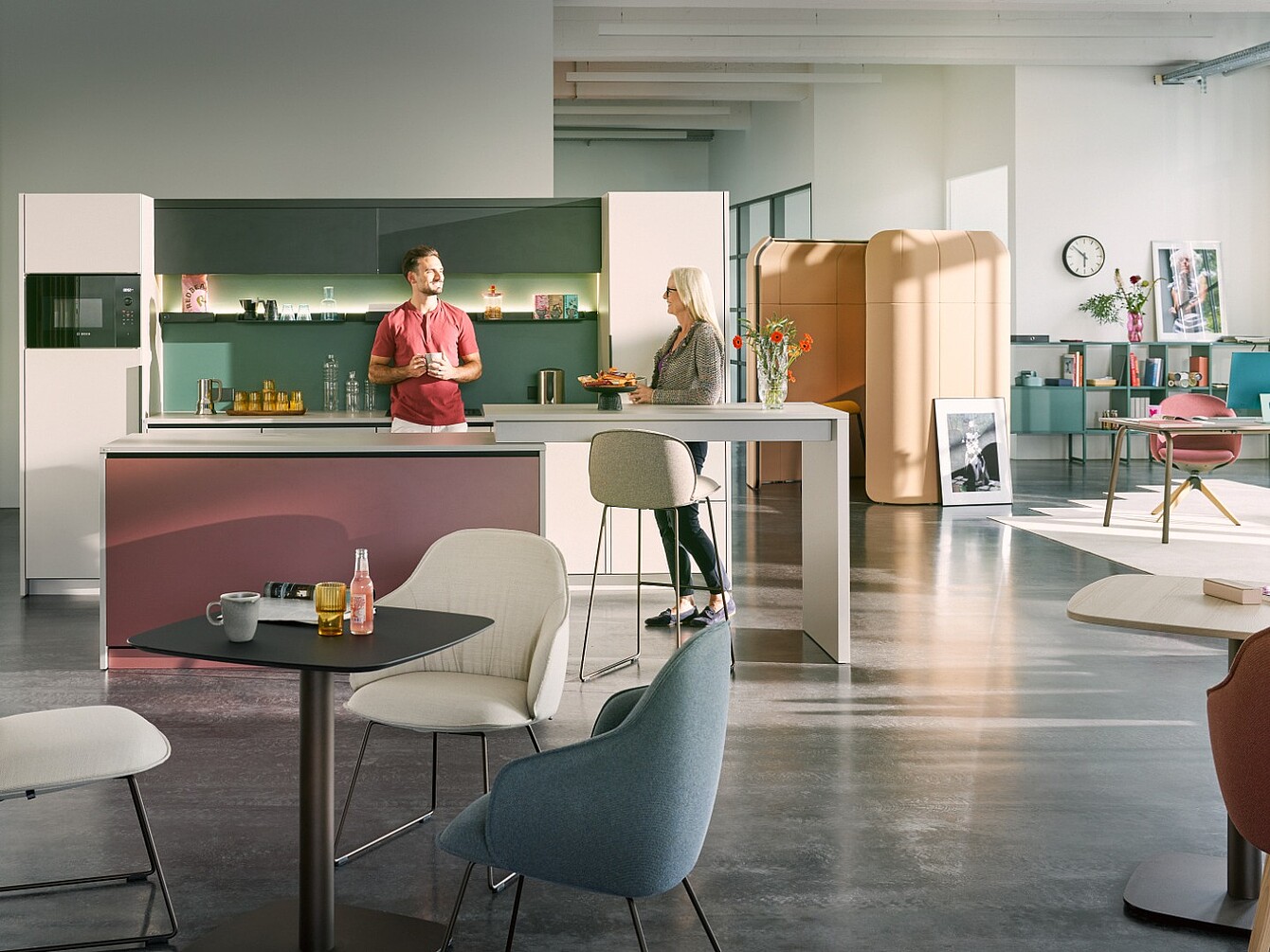
The Work Café is a good example of how one space can combine a variety of functions.
It is a meeting point, informal workspace, break area and communication space all at once. People gather there for different reasons – and that is precisely where its potential lies.
The Sedus article “The Work Café – New Spaces for Hospitality in the Office” describes how the qualities of so-called “Third Places” can be brought into the working world. Instead of a traditional break room, an inviting place emerges that combines spending time, connecting with others and working.
The article “The Work Café’s Dual Role: Encounters and Individual Work – How Productive Focus Spaces Emerge” takes this a step further. It shows that social spaces need not be exclusively loud and communicative. With the right design, they can offer opportunities for both encounters and individual work.
This is precisely the strength of versatile spatial concepts: Spaces are not restricted to a single function, but can accommodate different needs at the same time.
Hybrid work is changing the role of the office
Hybrid work has not made the office irrelevant.
Its purpose has changed.
In the past, for many employees the office was simply the place where work happened.
Today, it is part of a larger working ecosystem.
Focused individual work can take place at home. A quick coordination meeting works digitally. Documents and information are available almost anywhere.
So why come into the office?
The answer increasingly lies in qualities that cannot be fully replicated digitally:
- Personal closeness
- Spontaneous encounters
- Shared experiences
- Social connection
- The direct exchange of complex ideas…
…and the feeling of being part of an organisation.
This also changes the benchmark for good office design.
The number of desks does not determine the quality of a work environment.
What matters is the value it offers to the people who use it.
The Sedus article “The New Workflow: How Companies Can Keep the Office at the Centre of Hybrid Work” explores precisely this idea. It sees the office as the hub of a hybrid working ecosystem that must offer qualities of its own compared with home offices and other workplaces, from collaboration and inspiration to spaces for retreat and focused work.
From a place of work to a place of connection
This gives time spent together in the office a different meaning.
The key question is no longer simply:
Can employees work here?
But rather:
What can they experience, develop or achieve together here more effectively than elsewhere?
That also changes the approach to planning.
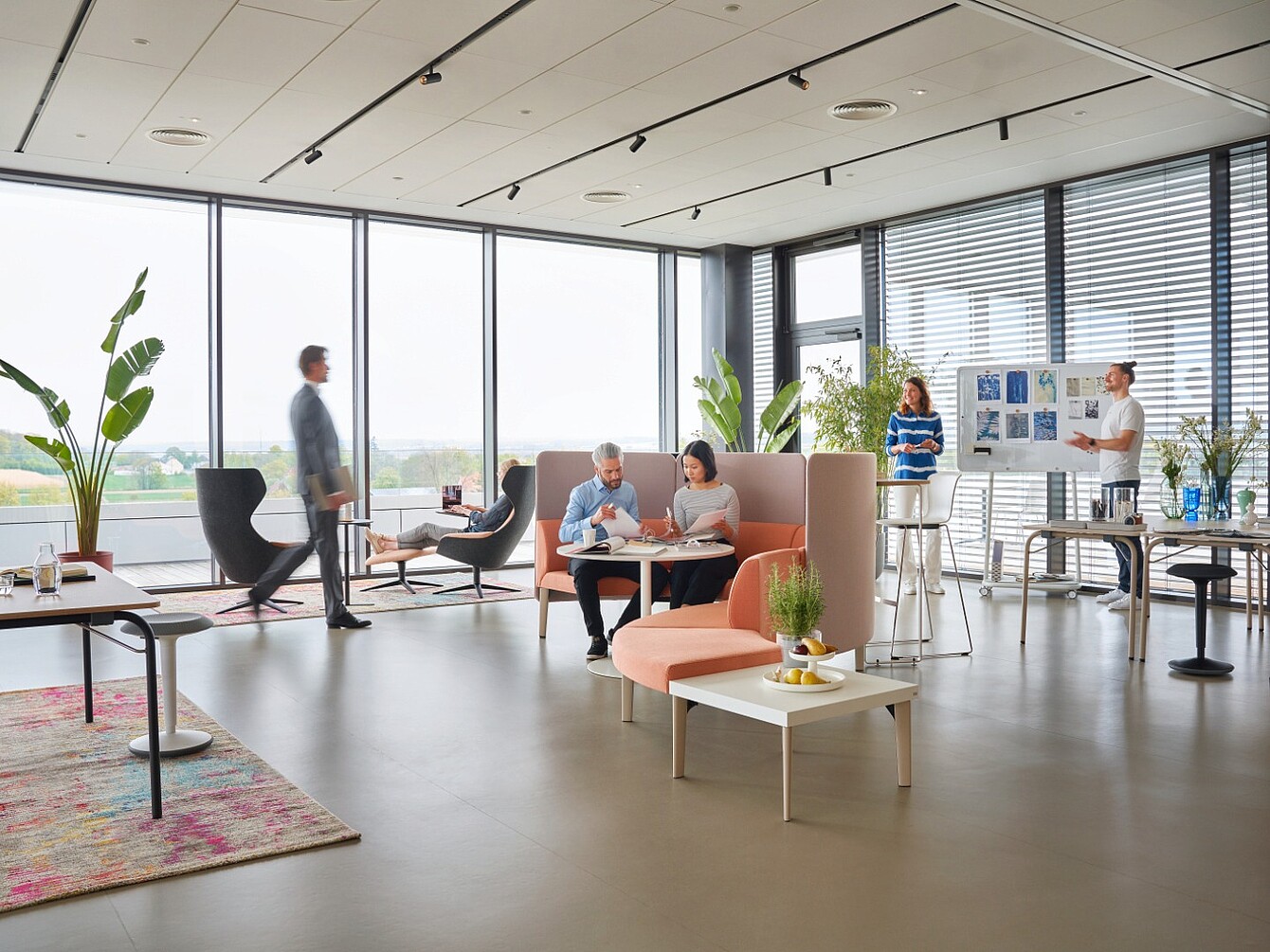
Areas that were once filled almost exclusively with desks can be designed in a more differentiated way. Collaborative areas are gaining importance. Informal meeting points are deliberately incorporated into plans. Retreat spaces provide a counterbalance to open zones.
The office is evolving from a standardised place of work into an environment that connects different activities and social needs.
The Sedus article “How Can Hybrid Office Design Truly Bring People Together?” also shows how such hybrid spaces can genuinely connect people. Particular emphasis is placed on atmosphere, social closeness and the combination of different ways of using space.
When space strengthens well-being, culture and belonging
Good work requires energy.
And energy is not unlimited.
People cannot concentrate for eight hours straight. Nor can they communicate, be creative or make decisions continuously.
A productive working day is made up of transitions between:
- Tension and relaxation
- Communication and retreat
- Concentration and movement
- Activity and breaks
Work environments can make these transitions easier.
When a suitable place is available for focused tasks, people do not have to fight their surroundings as much to maintain their attention.
When retreat is possible, mental pressure is relieved.
When informal areas invite a brief change of scene, breaks can become a more natural part of the working day.
And when light, acoustics, ergonomics, materials and indoor climate are considered together, the environment supports people instead of creating additional strain.
Well-being and productivity are not opposites.
On the contrary, a work environment that takes human needs into account creates an important foundation for sustained performance.
Sedus also explores this connection in the article “five Simple Measures Companies Can Take to Improve Well-being Immediately”. Daylight and indoor climate, acoustic and visual privacy, thoughtfully designed feel-good areas and places for encounters are among the key starting points.
Corporate culture becomes tangible through space
But spaces affect more than individual well-being.
They also send messages.
Anyone entering a company notices more than furniture and architecture.
They perceive an attitude:
- How open is the environment?
- How high-quality does it feel?
- Is there room for encounters?
- Are there opportunities to retreat?
- How naturally can different ways of working coexist?
- And how visible is the company’s identity?
The work environment thus becomes part of corporate communication.
But it does not communicate through a campaign or a slogan.
It communicates through experience.
A company that identifies collaboration as a core value but barely makes this exchange possible in its spaces creates a contradiction.
The same applies to a company that wants to encourage personal responsibility but offers only one type of workstation.
Corporate culture and space should therefore be considered together.
The key question is not just:
What should our office look like?
But rather:
How do we want to work together in this office?
When design supports the answer, corporate culture becomes tangible through space.
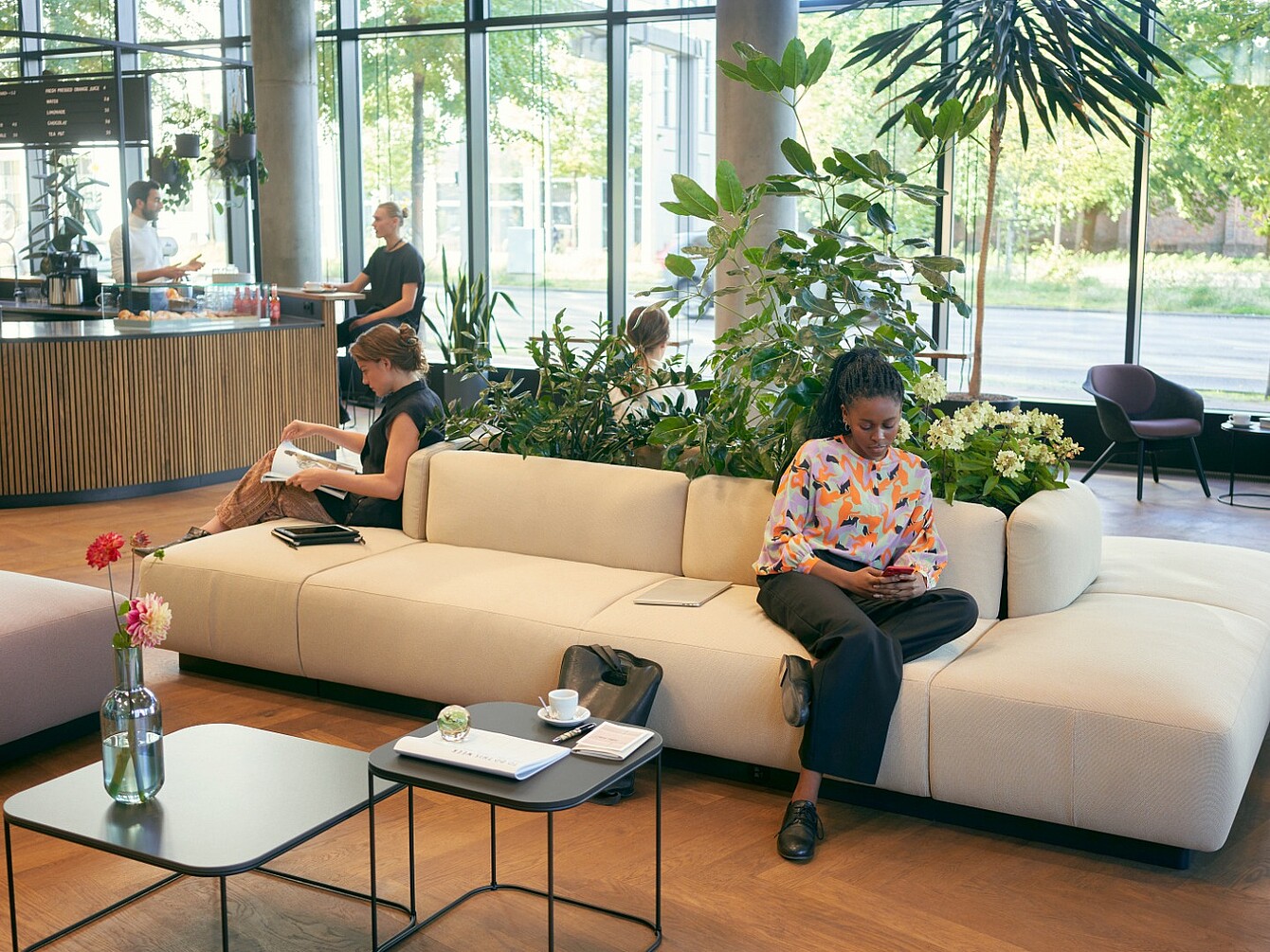
Customers, applicants, partners and visitors also perceive this impact. An office thus becomes a company’s three-dimensional business card: a place where corporate identity is not only visible, but can actually be experienced.
The Power of Space: Work environments as a strategic factor
Spatial design is often initially regarded as a matter of interiors.
But its impact reaches much further.
When a working environment makes collaboration easier, it influences processes.
When it conveys identity, it influences culture.
When people enjoy working there, it influences the company’s attractiveness.
When different ways of working are possible, it supports flexibility.
And when spaces can adapt to new requirements, they can help companies respond better to change.
Sustainability also plays an important role here. Durable materials, flexible furnishing concepts and spaces that can be adapted to changing requirements can help use resources more consciously and make work environments usable over the long term.
The most sustainable solution is often the one that lasts for many years. That is why flexible space concepts and durable products are becoming increasingly important for designing work environments that conserve resources and are future-proof.
The work environment thus becomes a strategic resource.
Not every effect can be expressed immediately in a key figure.
Yet many small effects add up:
- A conversation happens more quickly.
- An idea is developed further spontaneously.
- An employee finds the right place for a demanding task.
- An applicant gains a sense of the company’s culture on her very first visit.
- A team enjoys coming together because shared office time offers genuine added value.
The value of a work environment therefore does not arise solely from its floor plan.
It arises from what that floor plan makes possible.
Sedus also explores this broader connection in the article “How People, Spaces and Ways of Working Can Be Experienced Positively”. At its heart is a human-centred perspective that considers people, space and technology together in order to foster productivity, well-being and collaboration.
The question of the perfect office cannot therefore be answered with a single spatial concept.
Companies are different.
Teams are different.
Tasks are different.
And people are different.
Good work environments do not start with furniture.
They start with people’s needs:
- What do people need in order to concentrate?
- What brings them into contact with each other?
- Where can new ideas emerge?
- What kind of environment creates a sense of belonging?
- When do employees need stimulation, and when do they need calm?
Only by asking these questions can a space emerge that does more than simply function.
A space that supports.
That inspires.
That creates connections.
And that makes culture visible.
The most powerful impact of a space is often not immediately apparent.
It is reflected in how naturally people use it.
In a team finding the right place for a spontaneous conversation.
In someone being able to work undisturbed for an hour.
In colleagues crossing paths.
In employees identifying with their surroundings.
And in the office being seen not as a place they are obliged to visit, but as a place where certain things simply work better.
That is precisely the Power of Space.
Good work environments do more than provide space for work.
They create the conditions for people to realise their potential, connect with one another and experience themselves as part of a greater whole.
Because a good space does more than accommodate an organisation. It can help make it stronger.

social media channels: