Press contact
Sedus Pressestelle
Christof-Stoll-Straße 1 (ehemalige Gewerbestraße 2)
79804 Dogern
Tel.: +49 (0) 7751 84 - 320
E-Mail: presse@sedus.com
Sedus Pressestelle
Christof-Stoll-Straße 1 (ehemalige Gewerbestraße 2)
79804 Dogern
Tel.: +49 (0) 7751 84 - 320
E-Mail: presse@sedus.com
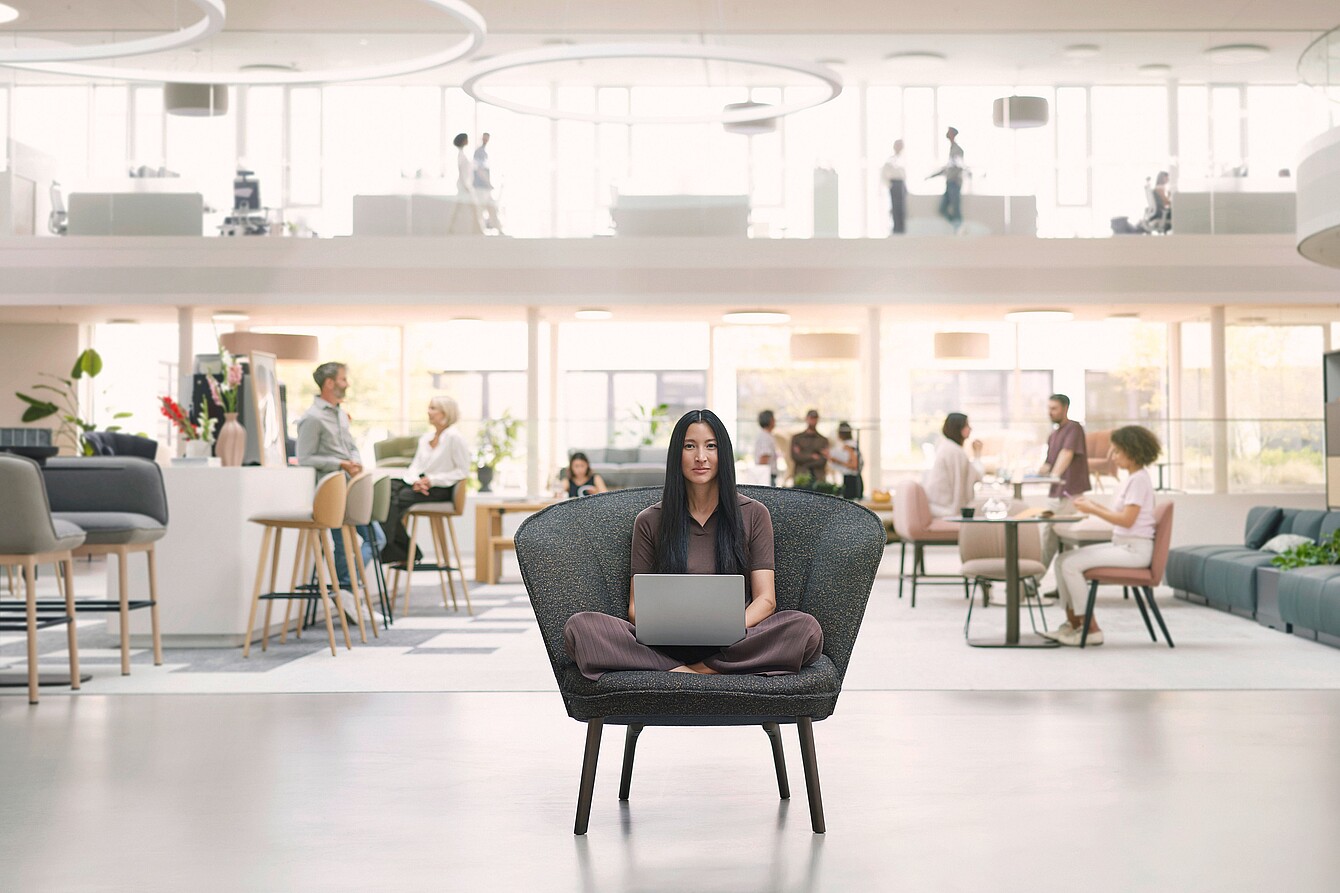
How can workplaces be designed to enable deep concentration while also encouraging exchange and collaboration? In the age of hybrid work, people are not returning to the office solely to connect and collaborate with colleagues in person. Increasingly, they are coming back to focus, to withdraw from distraction, and to reflect with intention. The challenge for organisations is to create work environments that support both needs – focus and interaction – with equal rigour.
Focused & Together – The Mindful Office, the guiding theme of the Sedus New Arrivals Winter 2025/2026, captures this tension precisely. It reflects a growing demand for mental clarity, acoustic comfort and spatial definition – particularly as open-plan layouts and limited opportunities for retreat in private living environments make concentrated work ever more difficult.
“We design workspaces consistently around human needs, creating environments in which focus and collaboration are intelligently balanced,” says Ernst Holzapfel, Marketing Director at Sedus. “Whether embedded in vibrant work cafés or in quiet retreat zones, they enable a new quality of work: individual, yet connected.”
Everyone perceives their environment differently. Every brain processes information and emotions in its own way. Neurodivergent individuals – including people with autism or ADHD – are often particularly sensitive to sensory stimuli such as light, noise or visual complexity. Neuro-inclusive workplace design addresses these realities directly. It creates environments that reduce overstimulation, provide orientation and deliberately support individual strengths – to the benefit of all employees. Key elements include clearly zoned areas for deep work, effective acoustic shielding, flexible retreat spaces, adaptable furniture, and transparent communication and work models that respond to different needs.
“Well-considered spatial concepts for different levels of focus – from deep focus to medium focus and light focus – are a core component of neuro-inclusive work environments,” Holzapfel explains. “Flexible acoustic furniture such as se:hive, as well as room-in-room solutions like se:cube and se:cube max, are central design elements for contemporary, needs-based work settings. We continuously evolve our solutions to make them more intuitive and inclusive – for example through the new touch display for se:cube and se:cube max, as well as additional modules for se:hive. The result is work environments that consciously address different sensory requirements.”
One of the internationally leading voices in neuro-inclusive workplace design is Kay Sargent. With almost 40 years of professional experience, the interior architect advocates for vibrant, inclusive work environments in her role as Senior Principal at HOK’s Interiors Group, placing strong emphasis on mentoring and innovation. In the current edition of LOOKBOOK N° 03, Kay Sargent discusses the principles and potential of neuro-inclusive work environments.
The full interview is available here: Lookbook N° 3.
29.01.2026
You can also download all the images and documents from the Sedus Media Center.