
Ergonomic workplaces are often taken for granted today – height-adjustable desks and flexible office chairs have long been standard in many companies. But is that enough? In this interview, we find out what ergonomics really means, what factors beyond furniture play a role and why even the best equipment is of little use if it is not used properly. It's a conversation about posture, responsibility and the challenges of modern working environments.
Mr Bakschas, before we get into the details, could you briefly tell us who you are, what your work focuses on and how you collaborate with Sedus?
My name is Jörg Bakschas, I am a freelance management consultant and have been working on the topic of "How will we live and work in the future?" for many years. In relation to the office furniture industry, I help companies set up new work spaces and get people on board so that they not only accept new ways of working, but also carry them out competently and enjoyably. A key focus of my work is the ergonomic design of modern spaces and training the people who want to work there. I also work as a standards expert for the Industry Association for Office and Work Environment (IBA). I have been working with Sedus for more than 15 years as a trainer and speaker on office-related topics.
How would you personally define "ergonomics"? Is it more of a science, an attitude or an everyday practice?
Ergonomics, translated from Greek, means "the science of adapting the working environment and work equipment to people". Since the 1960s, we in the office furniture industry have been working to design our work equipment, primarily desks and chairs, ergonomically. Over the years, we have added many levers to office chairs in particular so that they can be adapted to suit each individual. If the office chair is adjusted correctly for the individual user, it will provide optimum support in a wide variety of working positions at their office workstation. However, other factors such as acoustics, climate, lighting, etc. have also developed enormously over the years.
When you see a workplace for the first time, what are the first three things you look at?
When I see a workplace for the first time, I look at its orientation in the room in relation to windows, other workplaces and walkways. The second thing I look at is the person sitting at the desk in terms of their posture and use of the work equipment available at that particular workplace. Then I look at other factors such as lighting, acoustics and climate that are in situ at that workplace.
Beyond the furniture, which aspects have the greatest influence on the ergonomics of a workplace?
That's an interesting question, especially at a time when we are seeing completely new office environments that are designed to be highly flexible and adaptable to constantly changing tasks. Acoustics are a key factor in these new office spaces. That's why the first requests from employees when moving into such new spaces are usually for quiet areas or retreat rooms where they can concentrate on their work or make sensitive phone calls, for example.
What minimum ergonomic requirements can an employee expect from their employer today – for example, in terms of office chairs, desk height or equipment? And when, for example, is it justified to request a height-adjustable desk.
The minimum ergonomic requirements for a workplace in Germany are specified in the Workplace Ordinance (ArbStättV), and the corresponding Workplace Regulations (ASR) are designed in such detail that an ergonomic workplace must be available in the office for computer workstations. Nowadays, the demand for a height-adjustable desk is actually a matter of course, but in my opinion, this presupposes that it is actually used by people in practice.
What ergonomic misconceptions do you encounter most frequently?
What I often encounter in practice are modern, well-intentioned space concepts that, however, conflict in part with the actual use by employees. This is because the requirements for furniture and design are shaped by the tasks that will be performed there in the future. The acceptance of workstations or work surfaces depends not only on the goodwill of the employees, but also on their individual abilities.
What misconceptions about ergonomics would you like to dispel?
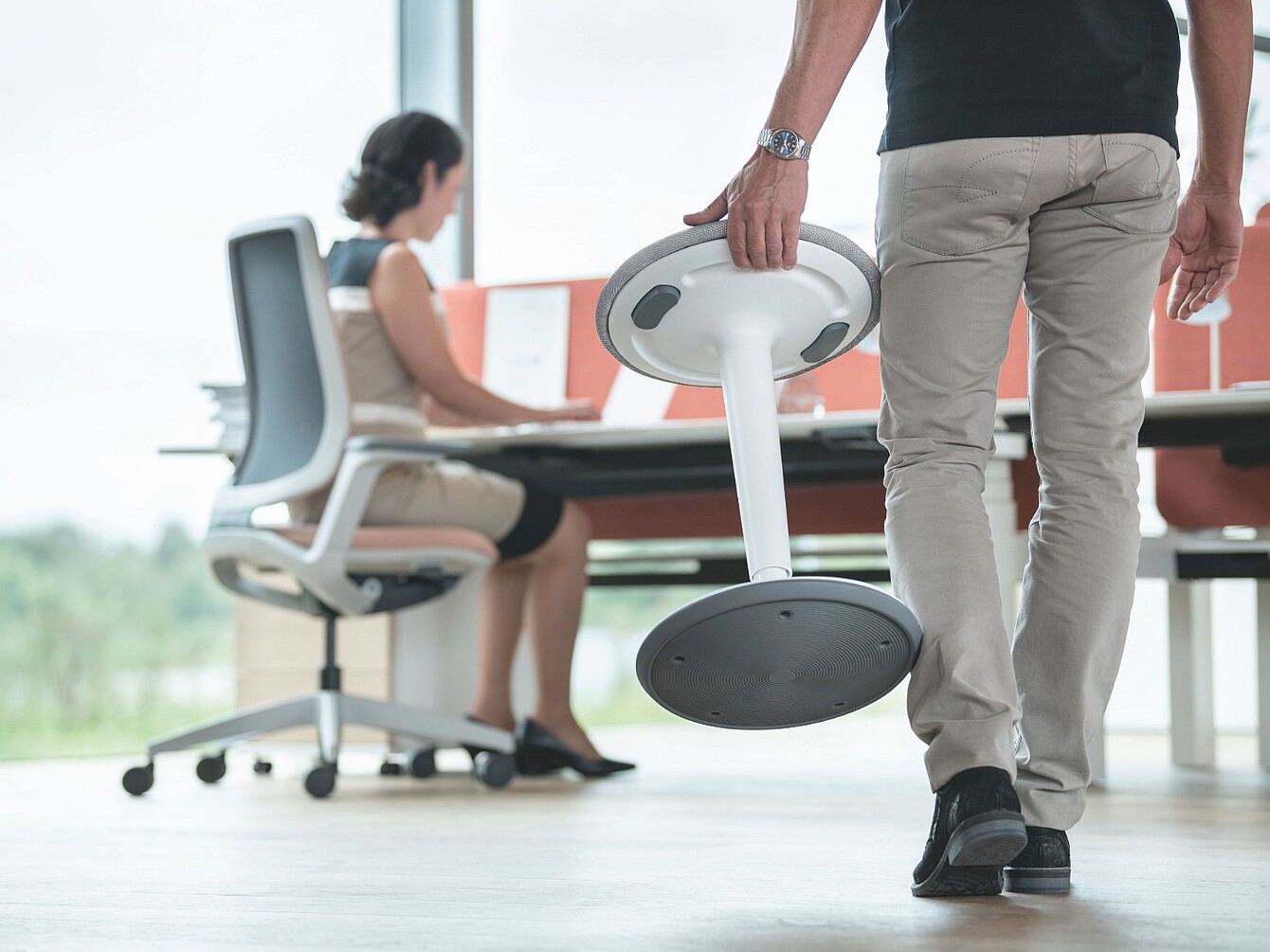
I think the most widespread assumption about ergonomics is that it is no longer something we need to concern ourselves with and that the employer bears full responsibility. From a purely legal point of view, the employer is obliged to provide appropriate work equipment, but a workplace can only be ergonomic if the user is prepared to adjust and use it correctly. To do this, they usually have to change their behaviour.
What role does personal responsibility play? How much can products achieve and how much do users have to do themselves?
Personal responsibility plays an essential role in today's fast-paced working world. I can provide users with the best tools, but they are useless if they are unwilling or unable to fully understand and use them. One key factor that the product must fulfil is to support the user's intuition so that essential functions are recognised. The more extensive the adjustment options are, for example in office swivel chairs, the greater the risk of incorrect operation, i.e. the possibility of adjusting the chair incorrectly. The way to avoid this is of course to properly train the end-user.
What ergonomic tips do you have for hybrid or mobile working in particular?
I could spend a whole day answering this question. To give just one quick tip, users should be aware that working with a screen device, whether fixed or mobile, in a home office or other third places, places the same demands on workplace design as in a corporate office. This means that the minimum work surface, the alignment of the workplace with the line of sight parallel to the window front and the use of a good swivel chair are also basic requirements for mobile working in order to remain fit and productive in the long term. In addition, good self-organisation and sensible working time management are also required.
How has the understanding of ergonomics changed in recent years – also in relation to new work trends?
This question has been on my mind for some time, and I'm afraid I have to say that, due to the AI bubble, which is completely overwhelming many people, and the sometimes frantic, trendy design of workspaces, very few people seem to be thinking about ergonomics at the moment. Instead, the focus is on space efficiency, attractive rooms and, above all, the latest information technology. In my experience, the latter in particular poses major problems for some companies, especially in communication rooms.
What are your hopes for the future of office ergonomics?
My clear wish for the future of office ergonomics is that it returns to the consciousness of the designers responsible, but also to that of the users. We are already seeing the increasing effects of improper use of mobile devices, which is manifested in conditions such as neck and shoulder pain. Companies have hardly any budget for prevention and user training, which I believe will come back to haunt them, because it is only a matter of time before we see an increase in sick days due to illnesses caused by working environments. Leaving employees to take responsibility for the design of their mobile workplaces, including financially, is simply short-sighted.
If you could give just one ergonomic tip that would have an immediate effect, what would it be?
I don't need to think long about that. My clear answer: as much movement as possible and short breaks during screen work!

Whether in the corporate office, at home or on the road, ergonomics remains a key issue for healthy and productive work. The interview with Jörg Bakschas shows that sustainable office ergonomics only works when product quality, room design and user behaviour work together. Movement, knowledge and awareness are just as important as good furniture – and ultimately an investment in the future of work.

social media channels: