
The AGR quality seal: “not a marketing label, but a genuine assessment”
The AGR quality seal is one of the most widely recognised awards for back-friendly products in Europe. It was developed back in 1995 in cooperation with Germany’s two largest back-care organisations: Forum Gesunder Rücken – besser leben e. V. and the Bundesverband deutscher Rückenschulen e. V.
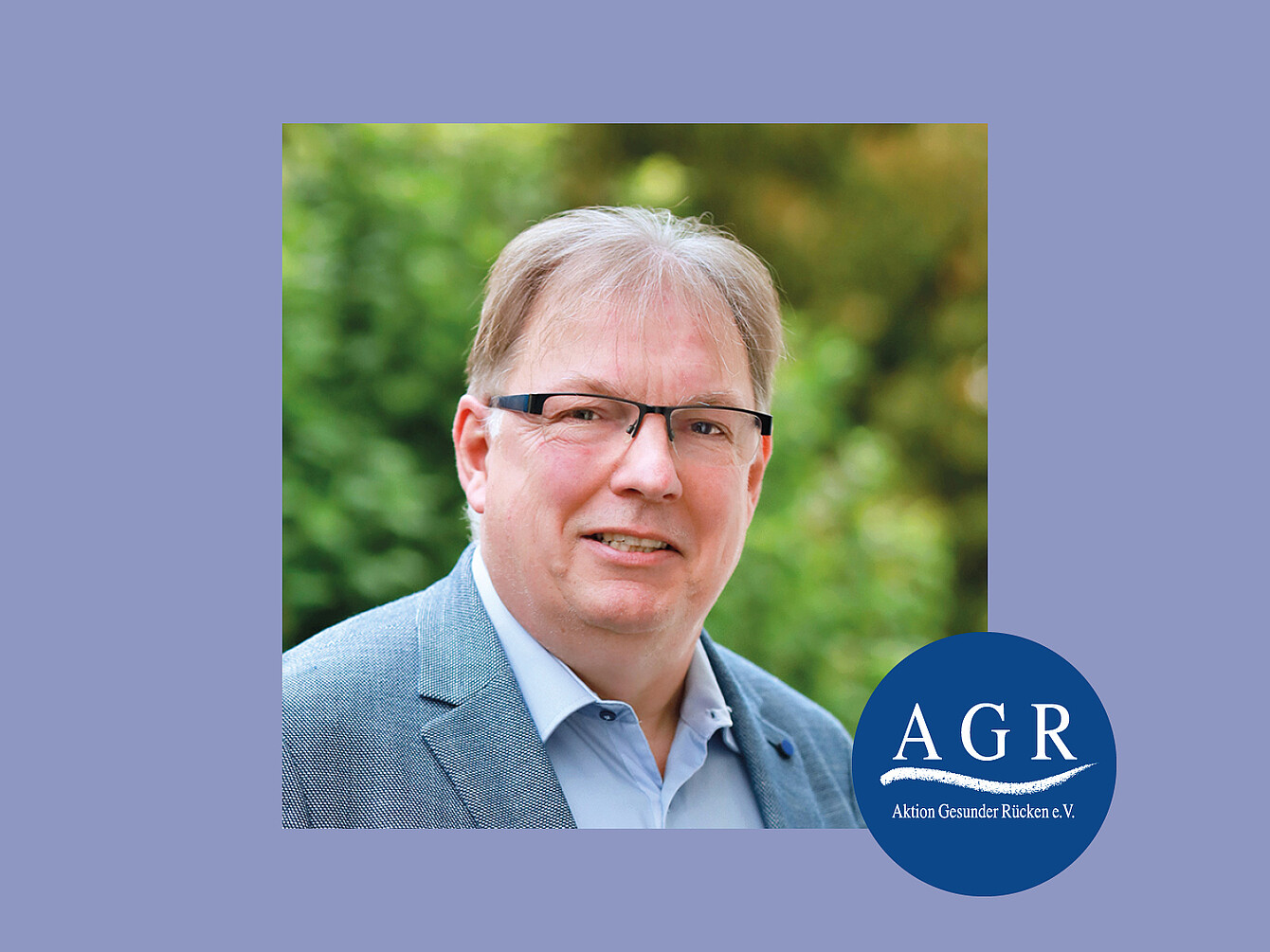
Detlef Detjen sums up its significance succinctly:
“The AGR quality seal ‘Tested & Recommended’ is one of the most recognised quality marks for back-friendly products in Europe.”
What lies behind the seal is not always immediately apparent to consumers. This is why Detjen emphasises what AGR truly stands for:
In a market flooded with self-awarded ‘quality labels’, the EU certification mark is an objective proof: the AGR seal is not a marketing label, but a genuine ergonomic quality assessment.
“Avoiding poor purchasing decisions” – benefits for consumers and organisations
When people invest in ergonomic products, they primarily want certainty: is it genuinely good – or just well marketed? This is precisely where the AGR seal comes in.
Detjen describes its practical benefit as follows:
“For consumers, it means transparent identification of genuinely back-friendly products – and thus avoiding poor purchasing decisions.”
For companies, verifiability plays an additional role, especially in tendering and procurement processes:
“For organisations, the AGR seal provides proof of ergonomic quality in tenders and procurement procedures.”
On a broader level, the focus is on prevention:
“From a health perspective, it means prevention and a reduction in back complaints through demonstrably ergonomic workplace equipment.”
What requirements must products meet?
Detjen makes it clear: the AGR quality seal is not awarded for ‘perceived ergonomics’, but only for products that demonstrably support back health.
“In principle, all products must verifiably promote back health and must not merely represent ergonomic compromises.”
The general principles include:
- Encouragement of movement – the product must enable and actively support movement
- Individual adjustability – accommodating different body dimensions and needs
- Intuitive operation – adjustment options must be easy to reach and understand
- Scientific validation – effectiveness must be supported by studies or ergonomic assessments
For seating products in particular, AGR pays close attention to criteria such as:
- Synchronous mechanisms or comparable technology
- Adjustable backrest resistance
- Lumbar support
- Seat depth and tilt adjustment
- Seat depth suspension
- 3D/4D armrests
- High-quality upholstery (a balance of comfort and support)
For workstation systems, the focus lies on height variability, stability and rapid adjustability – ensuring that sit-stand changes genuinely take place in everyday use.
The assessment process: “multi-stage and transparent”
The high level of acceptance enjoyed by the AGR seal is also due to its clearly structured process, designed to ensure maximum credibility.
Detjen describes it as:
“Multi-stage and transparent, designed to guarantee the highest level of credibility.”
The process includes:
- Application – manufacturers submit product information and ergonomic evidence
- Pre-assessment – a member of the assessment panel visits the manufacturer, inspects the product and reviews studies and reports
- Main assessment – twice a year, products are presented to the full panel, demonstrated in practice and intensively tested. The decision on certification is then made
- Post-certification – any changes must be reported and may require reassessment, ensuring long-term quality assurance.
Why Sedus products were awarded: “consistently high ergonomic standards”
Several Sedus products – including office chairs, height-adjustable desks and retreat spaces – bear the AGR quality seal. For the AGR assessment panel, this is not a snapshot, but the result of continuous development.
Detjen states:
“The award of the AGR quality seal to Sedus products is the result of decades of expertise in ergonomic product development.”
What particularly impressed the panel:
“For over 30 years, Sedus products have not only met individual criteria, but have consistently demonstrated a high ergonomic standard – from mechanics and controls to material quality.”
Office chairs: movement + adjustability + anatomy
Key factors for Sedus chairs included:
- Dynamic sitting – synchronous and kinetic mechanisms encourage natural movement and posture changes
- Intuitive adjustability – seat height, seat depth, lumbar support and armrests
- Anatomically shaped backrests with effective lumbar support
- Quality and durability
Desks: sit-stand dynamics
For height-adjustable desks:
- Stepless height adjustment
- Stable construction even at maximum height
- Promotion of frequent posture changes
Retreat spaces: health through spatial design
For retreat spaces, key aspects include:
- Acoustic optimisation
- Ergonomic integration of seating and work surfaces
- Flexibility for different usage scenarios
se:cube: effective relief for open spaces and lack of privacy
Open-plan offices and hybrid working models are now standard – yet not everyone benefits equally. Common complaints include noise, interruptions and lack of privacy.
With se:cube, Sedus provides an effective solution. Available in sizes S, M and L, the cubes create ideal environments for meetings, focused work or short breaks.
This goes beyond comfort: reducing noise and stress also alleviates muscular tension and contributes to back health – an aspect increasingly considered by AGR in its assessments.
early bird: ergonomics that set benchmarks

The swivel chair early bird combines classic design language with outstanding ergonomics – and is also AGR-certified. For Detjen, it is crucial that ergonomics is not seen as a ‘feature’, but as a fundamental principle:
“Encouraging movement and individual adjustability are core ergonomic principles.”
Especially during long periods of screen work, this makes all the difference. A truly good chair does more than support – it encourages movement and helps people stay healthy even after long working days.
se:lab: concepts instead of individual products – and a new AGR category
With the system programme se:lab, Sedus demonstrates how office planning has evolved. Today, the focus is less on individual products and more on holistic concepts.
Detjen explains:
“AGR has recognised that isolated individual products are only effective to a limited extent. Back health emerges from the interaction of multiple factors.”
Notably, a system as comprehensive as se:lab had never been certified before – simply because no suitable product category existed. Its diversity even prompted AGR to introduce a new category: ‘Concepts for agile working’.
se:lab invites users to interact with furniture, break routines and integrate movement into daily work – aligning perfectly with modern working styles based on collaboration, interaction and flexible spatial zones.
EUIPO recognition: “credible and trustworthy” – official status as an EU certification mark
A major milestone for AGR: since 2022, the quality seal has been recognised by the EUIPO (European Union Intellectual Property Office) as an EU certification mark. According to Detjen, this sends a strong signal of quality:
“The EUIPO subjected the entire AGR assessment process to rigorous scrutiny and classified it as ‘credible and trustworthy’.”
The recognition confirms, among other things:
- Transparency and publicly accessible criteria
- Independence of the assessment body
- Expertise of the panel
- Consistent application of criteria
- Ongoing controls after certification
For Sedus, this brings clear advantages:
“Many manufacturers claim to offer ergonomic products – Sedus can prove it.”
Especially in tendering processes, this represents a powerful argument, combined with added legal certainty through trademark protection.
“More than a certification”: why long-term partnerships matter
Sedus and AGR share a long-standing collaboration. Detjen describes it very clearly:
“The long-term, 30-year partnership between Sedus and AGR is more than a product certification – it is an expression of a shared mission for back health.”
Why is this so important?
“AGR seeks manufacturers who understand ergonomics not as a marketing trend, but as a core competence.”
Long-term partners not only deliver consistent quality, but also contribute practical experience that feeds back into the further development of assessment criteria. This creates a genuine dialogue between industry and the medical community – ultimately benefiting manufacturers, planners and users alike.
Three recommendations for tenders: making ergonomics measurable

In conclusion, Detjen offers three concrete recommendations for architects, planners and purchasers:
- Define certification as a minimum requirement
Example: “AGR quality seal or equivalent, independent ergonomic certification” - Focus on functional requirements rather than features alone
Emphasis on dynamic sitting, adjustability, lumbar support, armrests and intended duration of use - Think systemically rather than in isolation
Ergonomics emerges from the interaction of seating, desks, spatial solutions, training and service
This aligns perfectly with Sedus’ philosophy: health does not result from a single piece of furniture, but from a well-coordinated working environment.
“Certified specialist retailer”: making expertise in retail visible
Some Sedus dealers hold the distinction “Certified Specialist Retailer”. AGR’s aim is to make ergonomic advisory expertise clearly visible – enabling customers to find meaningful solutions and excellent advice more easily.
Detjen explains:
“The central objective of specialist retailer certification is to make ergonomic advisory expertise and certified ergonomic products visible and reliably accessible to customers.”
Certified retailers receive training and marketing support, are listed in AGR media, and offer end customers and organisations trained contacts who can explain products, adjust them correctly and provide individual recommendations.
The central objective of specialist retailer certification is to make ergonomic advisory expertise and certified ergonomic products visible and reliably accessible to customers.
Conclusion: trust, standards and a holistic view of health
The AGR quality seal is more than a mark on a product. It stands for independent, scientifically grounded assessment and provides orientation – both in the consumer market and in professional environments.
The fact that Sedus solutions, such as early bird, se:cube and se:lab have been awarded the AGR seal demonstrates that ergonomics at Sedus is not a detail, but an integral part of a holistic approach to health-promoting workplaces.
Or, as Detlef Detjen puts it: “Sedus understands ergonomics not as a product feature, but as a corporate philosophy.”

social media channels: